Anyone feel that fibro is hereditary? And also does anyone feel that exercising helps with it at all?
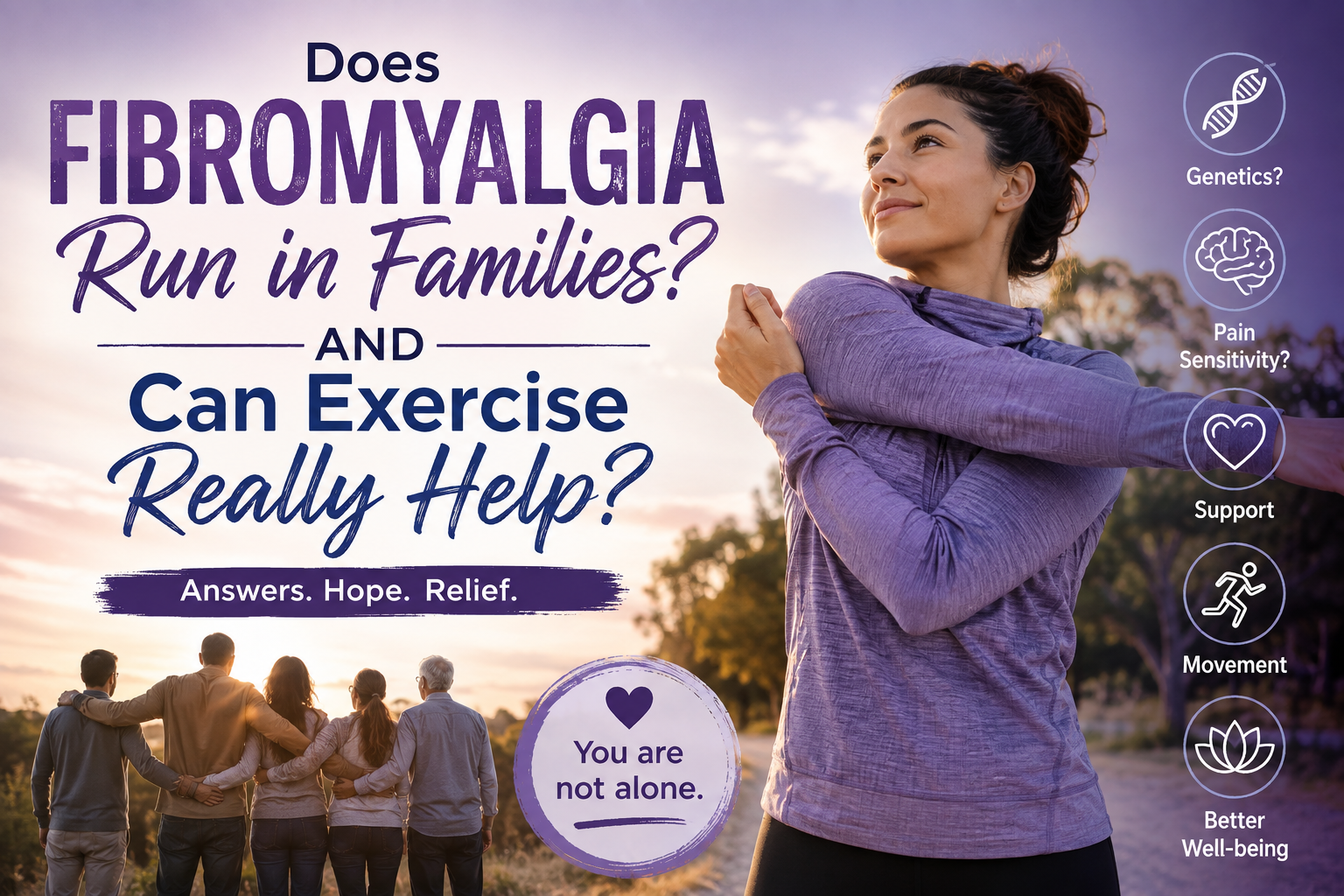
Does Fibromyalgia Run in Families? And Can Exercise Really Help?
Understanding the Possible Hereditary Link and the Role of Exercise
Fibromyalgia is a chronic condition associated with widespread pain, fatigue, sleep problems, and changes in how the nervous system processes pain.
Many people living with fibromyalgia eventually ask two important questions:
“Could I have inherited this?”
And:
“Can exercise actually make me feel better?”

Both questions are reasonable.
Research suggests that fibromyalgia can occur more often within some families.
However, that does not mean there is one single “fibromyalgia gene.”
At the same time, exercise can be helpful for many people with fibromyalgia.
But the type, intensity, and pacing of exercise matter greatly.
For someone with fibromyalgia, exercising too much or increasing activity too quickly can sometimes make symptoms worse.
The goal is usually not intense training.
The goal is finding a sustainable level of movement that supports the body without repeatedly triggering a flare.
Is Fibromyalgia Hereditary?
Fibromyalgia is not considered a straightforward inherited disease.
You generally do not inherit fibromyalgia in the same way that someone might inherit certain genetic conditions.
Instead, research suggests that genetic factors may increase susceptibility.
This means some people may be biologically more vulnerable to developing fibromyalgia.
Environmental and physical factors may also play a role.
These can include:
Long-term stress
Physical trauma
Certain illnesses
Sleep disruption
Other chronic pain conditions
Psychological stress
Changes in the nervous system
Other individual biological factors
The combination may be different for every person.
Does Fibromyalgia Run in Families?
Yes, fibromyalgia can appear to cluster in families.
People who have a close relative with fibromyalgia may be more likely to develop the condition than people without that family history.
This observation has encouraged researchers to investigate genetics.
However, family clustering does not prove that the condition is directly inherited.
Families share more than genes.
They may also share:
Lifestyle
Stressors
Sleep habits
Environmental exposures
Health conditions
Coping patterns
Social circumstances
Therefore, researchers believe the explanation is probably more complicated than a single inherited gene.
Is There a Fibromyalgia Gene?

There is no single gene that explains fibromyalgia.
Researchers have studied numerous genetic variations that could influence pain sensitivity and nervous-system function.
Some genetic differences may affect how the body responds to pain.
Others may influence neurotransmitters or other biological pathways involved in pain processing.
But having one of these genetic variations does not mean someone will definitely develop fibromyalgia.
Genes are only part of the picture.
What Does “Genetic Susceptibility” Mean?
Genetic susceptibility means that someone’s biology may make them more vulnerable to developing a particular condition.
Think of it as increased risk rather than certainty.
A person might have a genetic tendency toward greater pain sensitivity.
Another person may have a different biological profile.
Neither situation guarantees that fibromyalgia will or will not develop.
This is why two members of the same family can have completely different experiences.
One person may develop fibromyalgia.
Another may never develop chronic widespread pain.
Can a Parent Pass Fibromyalgia to a Child?
There is currently no simple inheritance pattern showing that a parent directly passes fibromyalgia to a child.
A parent may pass along genetic factors associated with susceptibility.
But that does not mean the child will automatically develop fibromyalgia.
Many people with fibromyalgia have no known family history.
Likewise, some people with a family history never develop the condition.
Why Does It Sometimes Seem to Run in Families?
There are several possible explanations.
Genetics may be one.
Shared environmental factors may be another.
Families can also share patterns of sleep, activity, stress, and healthcare.
Researchers continue to study how these factors interact.
The important point is that fibromyalgia is considered a complex condition.
It is unlikely to have one simple cause.
Can Fibromyalgia Be Predicted by Family History?
Not reliably.
Having a relative with fibromyalgia may be useful information for a doctor.
But family history alone cannot predict whether someone will develop the condition.
There is currently no routine genetic test that can tell someone:
“You will develop fibromyalgia.”
Diagnosis remains based on symptoms, medical history, and clinical evaluation.
Why Are Researchers Interested in Genetics?
Understanding genetics could eventually help researchers understand why some people develop chronic pain while others do not.
It may also help identify different biological pathways involved in fibromyalgia.
In the future, this knowledge could potentially contribute to more individualized treatment.
But genetic research is still developing.
Now, What About Exercise?
The second question is just as important.
Can exercise actually help fibromyalgia?
For many people, yes.
Research has generally found that appropriate physical activity can help improve several fibromyalgia symptoms.
Potential benefits include:
Reduced pain sensitivity
Better physical functioning
Improved mood
Better sleep
Increased strength
Improved endurance
Greater confidence with movement
Reduced physical deconditioning
However, exercise is not a cure.
And exercise does not work exactly the same way for everyone.
Why Can Exercise Feel So Difficult With Fibromyalgia?
People with fibromyalgia may experience widespread pain and fatigue.
Even ordinary activities can sometimes feel exhausting.
This can create a difficult cycle.
Pain may lead to less movement.
Less movement can contribute to reduced strength and conditioning.
Reduced conditioning can make everyday activity feel harder.
That can increase fatigue.
The result can be a cycle that is difficult to break.
Gentle, gradual activity may help some people interrupt that cycle.
Does Exercise Make Fibromyalgia Worse?
It can temporarily increase symptoms, especially if the activity is too intense or increased too quickly.
This does not necessarily mean exercise is harmful.
It may mean the body was asked to do more than it could comfortably tolerate at that moment.
This is why pacing is important.
The goal is not:
“Push through the pain.”
The goal is:
“Find a manageable amount of movement and build gradually.”
What Type of Exercise Is Best?
There is no single perfect exercise for everyone.
Different forms of movement may be useful.
Examples include:
Walking
Swimming
Water exercise
Gentle cycling
Stretching
Mobility exercises
Low-impact aerobics
Strength exercises
Yoga
Tai chi
The best exercise is often the one that a person can perform consistently and safely.
Walking
Walking is one of the simplest forms of physical activity.
It requires little equipment.
It can also be adjusted easily.
Someone who is struggling with fatigue may begin with a very short walk.
Another person may tolerate longer walks.
The important thing is individual tolerance.
Swimming and Water Exercise
Water can provide support and reduce the impact placed on joints.
Some people with widespread pain find warm-water exercise particularly comfortable.
Swimming is not necessary.
Simple movements in a pool can also provide physical activity.
Stretching
Gentle stretching may help maintain mobility.
It can also feel soothing for some people.
Stretching should not be forced.
Slow movements are generally more appropriate than aggressive stretching.
Strength Training
Strength training can help improve muscle strength and physical function.
For someone with fibromyalgia, starting with very light resistance may be appropriate.
Exercises can be modified according to ability.
The objective is gradual improvement rather than maximum performance.
Yoga
Gentle yoga may combine:
Movement
Flexibility
Breathing
Relaxation
Body awareness
Some people with fibromyalgia find this combination helpful.
However, difficult poses are not necessary.
A gentle approach is often more appropriate.
Tai Chi
Tai chi uses slow, controlled movements.
It may be suitable for people who find high-impact exercise difficult.
Its slow pace can make it easier to modify.
Exercise and Fatigue
It may seem strange to suggest exercise when someone already feels exhausted.
But regular, appropriately paced physical activity can sometimes improve energy and physical function over time.
The key is avoiding the “all or nothing” approach.
Doing too much on a good day can sometimes lead to a difficult recovery afterward.
Consistency is generally more useful than occasional bursts of intense activity.
The Importance of Pacing
Pacing means balancing activity with the amount of energy available.
For example, instead of exercising intensely once a week, someone might choose shorter sessions more regularly.
This can make activity more manageable.
Pacing is particularly important for people who experience significant symptom fluctuations.
What If Exercise Triggers a Flare?
First, don’t automatically assume that you have failed.
Look at what changed.
Perhaps the duration was too long.
Perhaps the intensity was too high.
Perhaps several activities were combined on the same day.
Perhaps recovery time was insufficient.
A healthcare professional or physical therapist can help adjust the program.
Exercise Should Not Be a Punishment
Exercise should not be viewed as something a person must endure because they are “not trying hard enough.”
Fibromyalgia is not simply a fitness problem.
A person can be physically active and still experience significant symptoms.
Exercise is one management strategy.
It is not proof that someone is cured.
What About Exercising During a Flare?
During a significant flare, the appropriate level of activity may be different.
Some people may need to reduce intensity or duration temporarily.
Complete inactivity is not always necessary or helpful.
Gentle mobility may be more realistic than a full workout.
The safest approach depends on the person’s symptoms and other health conditions.
Why Gradual Progress Matters
The body needs time to adapt.
Increasing activity too rapidly can produce excessive soreness and fatigue.
A gradual approach allows someone to learn their tolerance.
Progress may be measured in small ways.
For example:
Walking a little longer
Completing daily activities more comfortably
Recovering more easily
Feeling stronger
Sleeping better
Having greater confidence
These improvements can matter even if pain does not disappear.
Exercise Is Not the Same as “Cure”
This distinction is important.
Exercise may reduce symptoms or improve functioning.
It does not mean fibromyalgia has disappeared.
Someone can benefit from exercise while still having fibromyalgia.
Treatment should be individualized.
Can Exercise Improve Sleep?
Physical activity may help some people sleep better.
Better sleep can have a positive effect on pain, fatigue, and mood.
However, exercising very late or exercising too intensely may not work well for everyone.
Finding the right timing can take experimentation.
Can Exercise Help Mood?
Regular physical activity can support mental well-being.
It may help reduce stress and improve mood.
Living with persistent pain can be emotionally exhausting.
Having an activity that provides a sense of progress can be valuable.
What If Someone Cannot Exercise Much?
That does not mean they are doing something wrong.
Fibromyalgia severity varies.
Other medical conditions may also limit physical activity.
Movement can be modified.
Even gentle mobility exercises may be a starting point for some people.
A healthcare professional can help determine what is appropriate.
Listen to Your Body
“Listen to your body” does not mean avoiding every uncomfortable sensation.
It means paying attention to patterns.
Notice:
What activity increases symptoms?
How long can you tolerate it?
How long does recovery take?
Which activities feel comfortable?
What happens the next day?
Keeping a simple activity and symptom diary may help identify patterns.
The Next-Day Effect
One important consideration is how you feel after activity.
Someone may feel fine during exercise but experience increased symptoms later.
That information is useful.
It may indicate that the activity needs to be shortened or adjusted.
Finding Your Starting Point
There is no universal starting point.
For one person, five minutes may be realistic.
For another, twenty minutes may be comfortable.
The correct starting point is based on individual ability.
Starting too low may feel frustrating.
Starting too high may lead to a setback.
Finding the middle ground is the goal.
Should Everyone With Fibromyalgia Exercise?
Most people can benefit from some form of appropriate physical activity, but not every exercise program is suitable for every person.
People with other medical conditions, injuries, severe symptoms, or unusual new symptoms should seek professional guidance before changing their activity level.
When Should New Symptoms Be Checked?
Not every symptom should automatically be blamed on fibromyalgia.
New, severe, or unusual symptoms deserve medical evaluation.
Examples include:
New weakness
Significant swelling
Chest pain
Severe shortness of breath
Fainting
New neurological symptoms
Unexplained fever
A major change in usual symptoms
These should not simply be assumed to be “another fibro flare.”
Genetics and Exercise Are Connected in an Interesting Way
Genetic susceptibility does not mean someone is powerless.
Even if genetic factors contribute to fibromyalgia risk, many aspects of symptom management remain changeable.
Sleep, activity, stress management, medical treatment, and pacing can all be important.
Genes may influence vulnerability.
They do not necessarily determine the entire course of someone’s life.
Why Some People Respond Differently to Exercise
People with fibromyalgia are not identical.
One person may feel better after walking.
Another may prefer swimming.
Someone else may tolerate gentle strength training.
Another person may need extremely small amounts of activity.
This variation is normal.
The Goal Is Function, Not Perfection
A useful goal may be:
“What can help me live my life more comfortably?”
rather than:
“How can I exercise like everyone else?”
This shift can make physical activity less intimidating.
Exercise and Daily Activities
Exercise doesn’t have to mean going to a gym.
Daily movement counts too.
Examples include:
Walking around the house
Gardening
Gentle household activities
Taking short walks
Standing and moving periodically
Gentle mobility exercises
These activities can contribute to overall movement.
Avoid the “Boom and Bust” Cycle
A common pattern with chronic symptoms is doing too much on a good day and then needing significant recovery afterward.
This can become:
Good day → too much activity → increased symptoms → rest → reduced activity → repeat.
Pacing aims to make activity more consistent.
Small Improvements Matter
Someone may not notice dramatic changes immediately.
Progress might look like being able to:
Walk farther
Stand longer
Climb stairs more comfortably
Complete household tasks
Participate in social activities
Recover more quickly
These are meaningful improvements.
What Does the Research Suggest?
Overall, clinical research supports appropriately tailored physical activity as an important non-drug approach for fibromyalgia.
Aerobic activity, strengthening, flexibility work, and mind-body movement practices have all been studied.
Benefits vary between individuals.
The evidence does not mean that exercise eliminates fibromyalgia.
It means exercise can be a useful component of a broader management plan.
Exercise and Medication
Exercise does not necessarily replace medication.
Some people use medication alongside physical activity, sleep strategies, therapy, and other approaches.
Treatment should be individualized.
A doctor can help determine which options make sense for a particular person.
What About Rest?
Rest is important.
But too much prolonged inactivity can make returning to activity harder.
The goal is usually balance.
Activity and recovery should work together.
Can Exercise Reduce Pain Immediately?
Not necessarily.
Some people feel better after moving.
Others may initially experience increased soreness.
Long-term benefits may be more important than how someone feels during the first few sessions.
Don’t Compare Yourself With Healthy Friends
A person with fibromyalgia may have a very different exercise tolerance from someone without chronic pain.
Comparison can create unnecessary frustration.
Your starting point is your own starting point.
Don’t Compare Yourself With Other People With Fibromyalgia Either
Even people with the same diagnosis can have very different symptoms.
One person may walk several miles.
Another may struggle to walk around the house.
Both experiences are valid.
Is Exercise Worth Trying?
For many people, yes.
But it should be approached thoughtfully.
Start gradually.
Choose manageable movement.
Monitor your response.
Adjust when necessary.
And seek professional advice if you are uncertain.
What If Exercise Doesn’t Help Me?
That can happen.
Treatment response varies.
It does not mean your symptoms are imaginary.
It does not mean you are not trying hard enough.
It may mean the particular activity, intensity, timing, or overall treatment plan needs adjustment.
Fibromyalgia Is More Than Pain
Fibromyalgia can involve a broad range of symptoms.
People may experience:
Fatigue
Sleep problems
Cognitive difficulties
Headaches
Sensitivity to stimuli
Stiffness
Mood changes
Widespread pain
This is why management often needs to address more than exercise alone.
A Whole-Person Approach
A comprehensive approach may include:
Appropriate physical activity
Sleep support
Stress management
Education
Medical treatment
Healthy routines
Pacing
Psychological support when needed
No single strategy works for everyone.
So, Is Fibromyalgia Hereditary?
The best short answer is:
Fibromyalgia appears to have a genetic component, but it is not considered a simple inherited disease.
Family history may increase susceptibility.
But genes alone do not explain who develops the condition.
And Does Exercise Help?
The best short answer is:
Yes, appropriately paced exercise can help many people with fibromyalgia, particularly with physical function and overall symptoms.
But it should be individualized.
More exercise is not automatically better.
What Does “Appropriate” Exercise Mean?
Appropriate exercise means activity that matches your current ability.
It should be:
Gradual
Sustainable
Adaptable
Realistic
Safe
It should not repeatedly leave you unable to function afterward.
The Importance of Professional Guidance
A physical therapist familiar with chronic pain can be especially helpful.
They can assess movement and help design an individualized program.
This can be particularly useful if pain is severe or movement is difficult.
A Beginner’s Mindset
Instead of asking:
“How much exercise should I be doing?”
consider asking:
“What amount of movement can I consistently tolerate?”
That question may lead to a more sustainable approach.
Family History Can Be Worth Mentioning
If several relatives have chronic widespread pain or fibromyalgia, tell your healthcare professional.
It may provide useful background information.
But don’t assume every symptom is inherited.
Other conditions can cause similar symptoms.
Don’t Diagnose Yourself Based on Family History
Having a parent, sibling, or relative with fibromyalgia does not automatically mean your symptoms are fibromyalgia.
Persistent or unexplained symptoms deserve appropriate medical evaluation.
The Bottom Line
Fibromyalgia appears to involve a combination of genetic and environmental influences.
It can run in families, but it is not simply passed from parent to child through one known gene.
Family history may increase susceptibility without determining someone’s future.
Exercise is another area where individual differences matter.
Appropriately paced movement can help many people improve physical function, sleep, mood, and overall quality of life.
However, pushing through severe symptoms is not the goal.
The most useful exercise program is one that fits the person’s current abilities and can be maintained over time.
Fibromyalgia management is not about proving how much pain someone can tolerate.
It is about finding practical ways to improve life while respecting the body’s limits.
For some people, that may begin with a few minutes of gentle movement.
For others, it may involve swimming, walking, strengthening, yoga, or another low-impact activity.
The important thing is finding what works for you.
And when it comes to genetics, remember:
Having fibromyalgia in your family may increase your susceptibility, but it does not mean your future is predetermined.
There is still plenty that can be done to manage symptoms and support daily functioning.
If you live with fibromyalgia, your experience matters.
Your symptoms are real.
Your limits are real.
And your progress does not have to look like anyone else’s.
Small, consistent steps can still be meaningful.