Has anyone here been diagnosed with Degenerative disc disease and fibromyalgia?
Yes, many people suffer from both degenerative disc disease (spine wear) and fibromyalgia (widespread body pain) at the same time. These two conditions often occur together. Chronic back pain from the spine can trigger or worsen widespread nerve and muscle pain.
Has Anyone Here Been Diagnosed With Degenerative Disc Disease and Fibromyalgia?
Living with chronic pain can be complicated.
For some people, receiving one diagnosis finally explains years of discomfort.
For others, the diagnosis does not tell the whole story.
Some people are diagnosed with degenerative disc disease (DDD) and fibromyalgia at the same time.
Having both conditions can make it difficult to understand where particular symptoms are coming from.
Is the pain caused by the spine?
Is it related to fibromyalgia?
Could both conditions be contributing?
These are common questions.
Degenerative disc disease and fibromyalgia are different conditions.
However, their symptoms can overlap.
Both can be associated with chronic pain.
Both can affect sleep.
Both can contribute to fatigue and reduced activity.
And both can have a significant effect on everyday life.
What Is Degenerative Disc Disease?
Degenerative disc disease is a condition involving changes to the discs between the bones of the spine.
These discs act partly as cushions between the vertebrae.
They help the spine move and absorb forces.
As people age, spinal discs can gradually change.
The discs may lose some water content.
They can become less flexible.
Their structure can change.
Small tears or other changes may develop.
These changes are often described as degeneration.
Despite its name, degenerative disc disease does not necessarily mean that the spine is rapidly deteriorating.
In fact, many people have disc changes on imaging without experiencing significant pain.
That is important.
An MRI or X-ray can show structural changes.
But imaging does not always tell us how much pain a person will experience.
What Is Fibromyalgia?
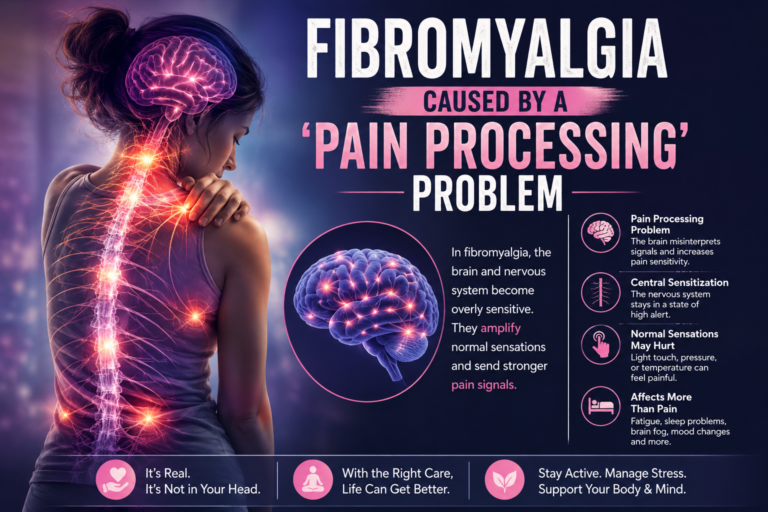
Fibromyalgia is a chronic condition associated with widespread pain and increased sensitivity to pain.
People with fibromyalgia may experience pain in multiple areas of the body.
They may also experience fatigue.
Sleep problems are common.
Some people experience difficulty concentrating or thinking clearly.
This is sometimes called “fibro fog.”
Symptoms can vary considerably from one person to another.
They can also change over time.
Some days may be manageable.
Other days may involve significant symptoms.
Can Someone Have Both Conditions?
Yes.
A person can have degenerative disc disease and fibromyalgia.
Having one condition does not prevent someone from developing another.
This can make diagnosis and symptom management more complicated.
A person may have genuine structural changes in the spine while also experiencing widespread pain associated with fibromyalgia.
It is important not to assume that every symptom must come from one condition.
Why Can the Pain Feel So Confusing?
Pain is not always simple.
For example, degenerative disc disease may contribute to pain that is more concentrated around the neck or lower back.
If a nerve becomes irritated or compressed, symptoms can sometimes extend into an arm or leg.
Fibromyalgia, on the other hand, is associated with widespread pain and altered pain processing.
A person with both conditions may therefore experience several different types of discomfort.
They may have localized back pain.
They may also experience widespread aching.
They may have tenderness in multiple areas.
They may experience fatigue at the same time.
This combination can make it difficult to identify the source of every symptom.
The Importance of a Proper Evaluation
When someone has chronic pain, it can be tempting to blame everything on the diagnosis they already have.
That can sometimes cause other problems to be overlooked.
A healthcare professional may consider the person’s symptoms, medical history, physical examination and, when appropriate, imaging or other testing.
The goal is not simply to find something abnormal on a scan.
The goal is to understand how the person’s symptoms fit together.
MRI Findings Do Not Always Equal Pain
One of the most important things to understand about degenerative disc disease is that imaging findings are common.
Many people without significant symptoms have disc changes.
Therefore, an MRI finding should be interpreted alongside symptoms and examination findings.
A scan can show that a disc has changed.
It cannot always explain the intensity of someone’s pain.
This can be especially important for someone who also has fibromyalgia.
Fibromyalgia Can Make Pain Feel More Widespread
Fibromyalgia involves changes in how the nervous system processes pain signals.
This does not mean that the pain is imaginary.
The pain is real.
The nervous system plays an important role in how pain is experienced.
When someone has fibromyalgia, painful sensations may be experienced more strongly or may occur across multiple areas.
This can make a localized spinal problem feel like only one part of a much bigger pain picture.
Back Pain and Fibromyalgia
Back pain is common among people with fibromyalgia.
However, back pain does not automatically mean that someone has degenerative disc disease.
Likewise, finding degenerative changes on an MRI does not automatically mean those changes are responsible for every symptom.
Doctors may need to consider several possibilities.
Muscle tension can contribute to pain.
Poor sleep can increase pain sensitivity.
Reduced physical activity can affect strength and mobility.
Spinal changes can contribute to localized pain.
Fibromyalgia can contribute to widespread sensitivity.
Several factors may exist at the same time.
Neck Pain Can Also Be Complicated
The same principle applies to neck pain.
Someone with degenerative changes in the cervical spine may experience neck discomfort.
They may also have headaches or pain extending into other areas depending on the underlying problem.
Fibromyalgia can add widespread muscle and body pain.
As a result, distinguishing one source from another can be challenging.
Fatigue Is Another Major Issue
Fatigue is commonly reported by people with fibromyalgia.
Chronic pain itself can be exhausting.
Poor sleep can make fatigue worse.
Living with persistent discomfort can make normal activities require more effort.
If someone is also dealing with painful spinal problems, fatigue may become even more difficult to manage.
A person may find that activities that used to feel easy now require breaks.
Sleep and Chronic Pain
Sleep is closely connected with pain.
People experiencing chronic pain may have difficulty falling asleep.
They may wake frequently.
They may struggle to find a comfortable position.
Poor-quality sleep can then make the following day more difficult.
For people with fibromyalgia, sleep problems can be particularly important because disrupted sleep may contribute to increased symptoms.
This can create a difficult cycle:
Pain can interfere with sleep.
Poor sleep can increase fatigue.
Fatigue can reduce activity.
Reduced activity can affect physical conditioning.
Pain may then become harder to manage.
Activity Can Be Difficult
People with both conditions may worry that exercise will make their symptoms worse.
That concern is understandable.
However, complete inactivity is not always helpful.
For many people, appropriately paced physical activity can support mobility and overall function.
The key is finding an appropriate level.
Starting too aggressively may trigger increased symptoms.
Starting gradually can be more manageable.
A healthcare professional or physical therapist can help develop an individualized approach.
Gentle Movement May Be Helpful
Depending on the person’s condition, gentle activities may include:
Walking.
Stretching.
Mobility exercises.
Water-based exercise.
Light strengthening.
Low-impact movement.
The goal is not to push through severe pain.
The goal is to gradually support function without repeatedly overwhelming the body.
Pacing Matters
Pacing can be especially useful for people living with chronic pain.
Instead of doing everything on a good day and then needing several days to recover, a person may divide activities into smaller sections.
For example, household tasks can be broken into manageable periods.
Rest breaks can be planned.
Physical activity can be increased gradually.
This approach may help reduce the cycle of doing too much followed by prolonged recovery.
Stress Can Affect Symptoms
Stress does not mean that someone’s pain is “all in their head.”
Stress can influence the nervous system, muscle tension, sleep and overall pain sensitivity.
Someone dealing with chronic pain may also experience frustration, worry and emotional exhaustion.
Managing stress is therefore part of overall self-care.
Relaxation techniques, supportive relationships, enjoyable activities and appropriate professional support can all be useful.
Living With Two Diagnoses Can Be Emotionally Difficult
Receiving multiple chronic pain diagnoses can be overwhelming.
A person may wonder whether the pain will ever improve.
They may worry about work.
They may worry about family responsibilities.
They may feel frustrated when others cannot see the condition.
Sometimes the hardest part is explaining that a person can look completely fine while still experiencing significant symptoms.
Being Believed Matters
People with fibromyalgia have historically reported feeling misunderstood.
Some have been told that their symptoms are simply stress.
Others have been told that nothing is wrong because their imaging does not show a major problem.
Neither extreme is helpful.
A person’s symptoms deserve to be taken seriously.
Pain does not have to be visible to be real.
There May Not Be One Single Cause
For someone with both DDD and fibromyalgia, searching for one explanation for every symptom may not always be productive.
There may be several contributors.
A spinal condition may contribute to some symptoms.
Fibromyalgia may contribute to others.
Sleep may influence pain.
Stress may influence symptoms.
Physical conditioning may influence function.
All of these factors can interact.
Treatment Usually Needs to Be Individualized
There is no single treatment plan that works for everyone with fibromyalgia and degenerative disc disease.
Treatment may depend on:
The location of pain.
The severity of symptoms.
Neurological symptoms.
Sleep quality.
Physical function.
Other medical conditions.
Medications.
Previous treatments.
Personal goals.
A healthcare professional can help determine which approaches are appropriate.
Medication Is Not the Only Tool
Medication may be part of treatment for some people.
However, chronic pain management often involves more than medication.
Physical therapy may be useful.
Activity modification may help.
Sleep management may be important.
Stress management may help.
Education about pain can also make a difference.
The best approach often combines several strategies.
Physical Therapy
Physical therapy can help some people improve movement, strength and function.
A physical therapist can assess movement patterns and develop exercises appropriate for the person’s abilities.
For someone with both spinal degeneration and fibromyalgia, an individualized program may be particularly important.
Exercises that are appropriate for one person may not be appropriate for another.
When Nerve Symptoms Need Attention
Spinal conditions can sometimes affect nerves.
Symptoms such as persistent numbness, weakness, or significant changes in sensation should be discussed with a healthcare professional.
Some symptoms require prompt medical assessment.
New or severe neurological symptoms should not simply be assumed to be fibromyalgia.
Don’t Assume Every New Symptom Is Fibromyalgia
This is an important point.
Having fibromyalgia does not mean every future symptom is caused by fibromyalgia.
Likewise, having degenerative disc disease does not mean every symptom comes from the spine.
New symptoms deserve appropriate evaluation.
This can help prevent potentially important problems from being overlooked.
Chronic Pain Can Change Daily Life
Living with both conditions may affect simple activities.
Getting out of bed may be difficult.
Sitting for long periods may become uncomfortable.
Standing may be tiring.
Housework may require more planning.
Long journeys may be challenging.
Even social activities can become exhausting.
These changes can be frustrating.
Small Goals Can Matter
When chronic pain limits life, small improvements can be meaningful.
Being able to walk a little farther.
Getting better sleep.
Completing a household task.
Having enough energy for family time.
Taking a short outing.
These may not sound dramatic to someone without chronic illness.
But for someone living with persistent pain, they can represent significant progress.
There Is No Shame in Resting
Rest is sometimes necessary.
However, rest and complete inactivity are not the same thing.
A person may need to balance activity and recovery.
The goal is to find a sustainable routine.
Listen to Your Body
Listening to your body does not mean avoiding all movement because of discomfort.
It means paying attention to patterns.
Which activities increase symptoms?
Which activities help?
How much activity is manageable?
How much recovery is needed?
Keeping a symptom diary can sometimes help identify patterns.
Good Days and Bad Days
Chronic pain conditions often fluctuate.
A person may have a relatively good day followed by a difficult one.
This variability can be frustrating.
It can also be misunderstood by other people.
Someone may ask:
“If you were feeling good yesterday, why can’t you do this today?”
Chronic illness does not always behave predictably.
A good day does not necessarily mean the condition has disappeared.
Family and Friends May Need Education
People around someone with chronic pain may not understand why plans sometimes have to change.
Explaining the conditions can help.
It can be useful to describe what support actually looks like.
Sometimes the most helpful thing is simply understanding.
Work Can Become Challenging
Sitting at a desk for long periods may aggravate some people’s back or neck symptoms.
Physical jobs may also be difficult.
Fatigue may affect concentration.
Pain may make commuting harder.
Workplace adjustments may sometimes help.
Depending on local laws and circumstances, reasonable accommodations may be available.
Emotional Health Matters
Chronic pain can affect mood.
Feeling frustrated does not mean someone is weak.
Feeling tired of dealing with symptoms is understandable.
Support from trusted people can be valuable.
Professional mental-health support can also help people develop coping strategies.
This does not mean the pain is psychological.
It means emotional wellbeing is an important part of living with a chronic condition.
The Role of Sleep
Improving sleep may be one of the most useful areas to focus on.
A consistent sleep schedule may help.
A comfortable sleeping environment may help.
Reducing stimulating activities close to bedtime may help some people.
Persistent sleep problems should be discussed with a healthcare professional.
Nutrition and Chronic Pain
There is no universally proven “fibromyalgia diet” or diet that reverses degenerative disc disease.
A balanced eating pattern can nevertheless support general health.
Adequate protein, fruits, vegetables, whole grains and appropriate hydration can be part of a healthy lifestyle.
People should be cautious about diets that promise to cure chronic pain.
Weight and Joint Stress
For some people, maintaining a healthy weight can reduce physical strain on the spine and joints.
However, discussions about weight should always be individualized and health-focused.
The goal should be improved wellbeing and function rather than pursuing an unrealistic body ideal.
Be Careful With Internet Claims
Chronic pain can make people vulnerable to products and treatments promising instant cures.
Be cautious about claims such as:
“One supplement cures fibromyalgia.”
“This exercise reverses disc degeneration.”
“This treatment works for everyone.”
“Doctors don’t want you to know this.”
Reliable medical information usually acknowledges uncertainty and individual differences.
Surgery Is Not Automatically the Answer
Degenerative disc disease does not automatically require surgery.
Many people manage spinal degeneration without surgery.
Surgery may be considered in specific circumstances, particularly when there is a clear structural problem causing significant symptoms or neurological complications.
The decision should be made with an appropriately qualified healthcare professional.
Fibromyalgia Does Not Mean Nothing Can Be Done
Fibromyalgia is chronic, but that does not mean a person is powerless.
Symptoms can sometimes be managed.
Function can sometimes improve.
Sleep can improve.
Activity tolerance can improve.
People can learn strategies that make daily life more manageable.
Progress may be gradual.
Hope Can Be Practical
Hope does not mean pretending everything is fine.
It means recognizing that symptoms can change and that management strategies can evolve.
A person may not eliminate every symptom.
But reducing the impact of symptoms can still make a meaningful difference.
Finding the Right Healthcare Team
Managing two chronic conditions may require communication among different professionals.
Depending on symptoms, someone may work with:
A primary-care clinician.
A rheumatology specialist.
A spine specialist.
A neurologist.
A physical therapist.
A pain-management professional.
Other healthcare professionals may also be involved.
The exact team depends on the person’s symptoms and healthcare system.
Keep a List of Symptoms
Before appointments, it can help to write down:
Where the pain occurs.
When it started.
What makes it worse.
What makes it better.
Whether there is numbness.
Whether there is weakness.
How sleep is affected.
How fatigue affects daily activities.
What treatments have been tried.
This information can make appointments more productive.
Ask Questions
Patients do not need to be afraid to ask questions.
Useful questions include:
“What symptoms do you think are coming from my spine?”
“Could fibromyalgia be contributing to my widespread pain?”
“Are there signs of nerve involvement?”
“What type of activity is appropriate for me?”
“What symptoms should make me seek urgent care?”
“Would physical therapy be appropriate?”
These questions can help create a clearer treatment plan.
You Are Not Alone
If you have been diagnosed with both degenerative disc disease and fibromyalgia, you are certainly not the only person trying to understand the combination.
Many people with chronic pain have more than one condition.
That can make symptoms confusing.
It can also make treatment feel like trial and error.
But your experience is valid.
Every Person’s Experience Is Different
One person may have severe spinal findings and relatively little pain.
Another may have significant pain with modest imaging findings.
Someone with fibromyalgia may experience widespread symptoms.
Another person may have a different symptom pattern.
There is no single “fibromyalgia experience.”
There is no single “DDD experience.”
The Most Important Message
Having degenerative disc disease and fibromyalgia can create a complicated pain picture.
It does not mean that your symptoms are imaginary.
It does not mean that everything is coming from your spine.
And it does not mean that everything is coming from fibromyalgia.
The best approach is to look at the whole person.
Pain.
Sleep.
Movement.
Fatigue.
Neurological symptoms.
Emotional wellbeing.
Daily function.
Medical history.
All of these pieces matter.
A Question for the Community
If you have been diagnosed with both degenerative disc disease and fibromyalgia, you may have your own experience to share.
When did you receive each diagnosis?
Did one diagnosis come years before the other?
Do you feel that your symptoms are mostly related to your spine, fibromyalgia, or a combination of both?
Have physical therapy, pacing, gentle movement, sleep improvement or other approaches helped you?
What has been the most difficult part of living with both conditions?
Sharing experiences can help others feel less alone.
At the same time, everyone’s medical situation is different, so personal experiences should not replace individualized medical advice.
Final Thoughts
Living with degenerative disc disease and fibromyalgia can be exhausting and confusing.
There may be days when pain dominates your attention.

There may be days when fatigue is the biggest problem.
There may be days when you feel relatively well.
That variability is part of chronic illness for many people.
Understanding that different conditions can contribute to different symptoms can be empowering.
Instead of asking, “Which diagnosis is causing everything?” it may sometimes be more helpful to ask, “What factors are contributing to my symptoms, and what can I do about each one?”
With appropriate medical evaluation, realistic activity, good symptom management, support and patience, many people can find ways to improve their quality of life.
You deserve to have your pain taken seriously.
You deserve to be heard.
And you deserve a treatment plan that considers the whole picture—not just an MRI report and not just a diagnosis.